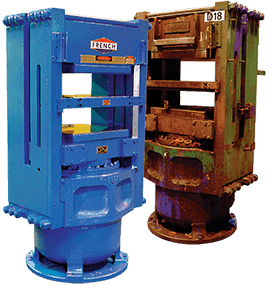
French 850 Ton Compression Molding Press Featured in New Educational Course
Driven by innovation and continuous improvement, French partners with THORS to feature a compression molding hydraulic press in their new STEM educational course.
At French Oil Mill Machinery Company, continuous improvement and innovation are an important part of our defined Core Values and our company’s culture. These principles are a key factor in our on-going success that originated with our founder, Alfred W. French, Sr.
After his graduation from MIT, French started his business career by investigating plant operations and making suggestions for improvements. French utilized his observations and began working on a plan to improve the efficiency of oil processing with his own engineered machinery. In April 1899, French received a patent for his first press and in 1900 French Oil Mill Machinery Company began as a new idea. French’s machinery advanced manufacturing processes and challenged industry methods. Since then, our designs have greatly evolved and the company touts more than 150 patents from our ongoing research and development.
Continuous improvement and innovation are a byproduct of a solid educational base, process observation and on-going training. Many times on-going training happens on the job but often times it is beneficial to seek outside training to stay competitive. As a result, our company and employees are staunch supporters of early and ongoing STEM education.
When approached by THORS eLearning Solutions to have one of our composite molding presses featured in their Polymer Fundamentals course, we were honored and pleased to partner with them and to participate. In the course materials, a French 850-ton downacting hydraulic press used to compression mold rubber components for the medical industry is pictured in the Polymer Manufacturing Processes section.
Polymer Fundamentals is an online eLearning course that enables participants to gain a comprehensive understanding of the characteristics, synthesis, properties, physical states and classifications of polymers. In addition, the course covers the most common processing methods available to manufacture polymer products, including compression molding, plastic blow molding, extrusion and pultrusion.
The course covers:
- The differences between natural and synthetic polymers, the advantages and disadvantages of polymers, as well as the naming conventions and the degree of polymerization.
- The methods of polymerization.
- The various chain architectures, chain chemistries and chain sequences of polymers and how they affect a polymer.
- The mechanical, thermal and functional properties of polymers.
- The contrasting physical states of polymers and the methods of polymer solidification.
- The classifications of polymers and their key differences.
- Polymer processing methods used in manufacturing.
The Polymer Fundamentals course was launched in Fall 2015 by THORS eLearning Solutions.
THORS eLearning Solutions offers online education, apps and productivity tools for manufacturing employees. Their courses span a variety of manufacturing industries and are designed to supplement an employee’s existing industry knowledge with information that is directly applicable to their job.